Rural areas access 10% as doctors face travel, fee issues in integrated care
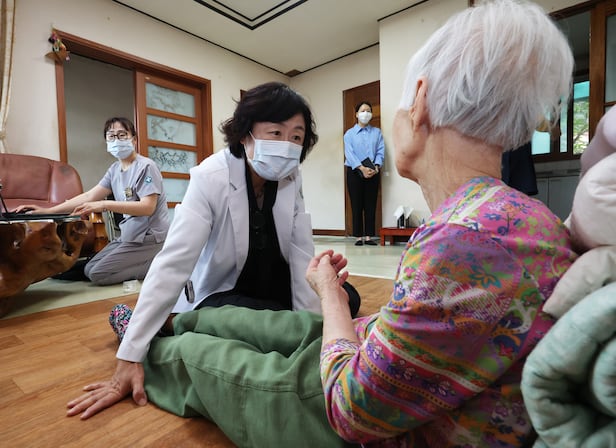
On June 11, medical staff from Gangneung Medical Center treat an elderly person with mobility difficulties
at a home in Seongsan-myeon, Gangneung City, Gangwon Province. According to a community integrated
care survey released by the Ministry of Health and Welfare on the 13th, the nationwide supply fulfillment rate
for home visit medical care compared to demand stands at 21.9%. /Jang Gyoung-sik
Dr. A, a private practitioner operating a civilian clinic in Namhae County,
Gyeongnam Province, makes home visits for patients who have applied for
home visit medical care only once every two weeks. Even then, he splits his
lunchtime to travel. Three of Namhae’s 10 towns and townships have no
civilian clinics at all, and if he closes his clinic to make a home visit, he cannot
treat patients who come to his office.
Home visit medical care, where doctors directly visit patients with mobility
issues, is considered a key part of the Lee Jae Myung government’s first
welfare project, the “community-based integrated care” system. However, it
was found that only about 20% of elderly and disabled people can actually
receive this service. In areas with population decline, the figure drops to
around 10%. The integrated care system, which allows the elderly and
disabled to receive medical, nursing, and care services in their homes without
entering hospitals or facilities, has been implemented nationwide since
March of this year.
According to the Ministry of Health and Welfare’s “Integrated Care Status
Survey” released on the 13th, the supply fulfillment rate for home visit
medical care nationwide was 21.9%. This figure compares the estimated
future demand for services with the current capacity of institutions and
personnel across 229 cities, counties, and districts. Home visit medical care
fell far short of other services under the integrated care system, such as
home care (96.9%) and home health management (75.6%).

In areas with population decline, the fulfillment rate for home visit medical
care was 10.7%, lower than the 25.5% in general areas. The average distance
to a home visit medical care provider also differed between areas with
population decline (18.8 km) and general areas (12.2 km). This implies that in
rural areas with fewer people, doctors must spend more time traveling for a single home visit.
The survey found that 66 of the 229 cities, counties, and districts nationwide
had higher-than-average demand for home visit medical care (elderly and
disabled people) but lower supply (institutions and personnel). These
included Namhae County in Gyeongnam, Cheongdo County in Gyeongbuk,
and Jangheung County and Jindo County in Jeonnam-Gwangju. A source
from the Namhae County Health Center said, “Only five clinics in Namhae
County participate in the home visit medical care program, and if the number
of people waiting increases, it becomes difficult to provide services on time,
making it hard to actively promote the service.” The county is adjusting the
ystem so that the number of people waiting does not exceed 10. Jangheung
County also has high demand for home visit medical care—third-highest
nationwide due to its large elderly population—but five of its 10 towns and
townships have no civilian clinics. This makes it difficult for participating
clinics to increase the number of home visits.
Critics point to limitations in the fee schedule system. The government only
provides an additional 20% of the fee per case for home visits in townships,
without extra payments based on actual travel distance. Moreover, even if a
doctor makes a home visit to an area with population decline, they do not
receive the township bonus if the administrative district is classified as a
“dong” (neighborhood). From the doctors’ perspective, waiting for patients to
come to their clinics may be more profitable than investing time in home visits.
The medical community has proposed alternatives, such as recognizing
home visits to places where the elderly gather, like day care centers or senior
centers. Jang Hyuk-jae, CEO of Ontact Health (a cardiology professor at
Severance Hospital), who has developed AI-based medical diagnostic
technology and mobile medical bus systems, said, “Expanding the scope of
recognized home visit medical care to allow elderly people with mobility to
receive treatment at nearby places like day care centers, and actively utilizing
mobile medical buses equipped with AI medical devices, could enable more
patients to be treated with fewer personnel.”
-
PREV 리벨리온·퓨리오사AI·온택트헬스 등 8개社, 26년 상반기 우수연구개발 혁신제품 지정
-
NEXT No next post.